

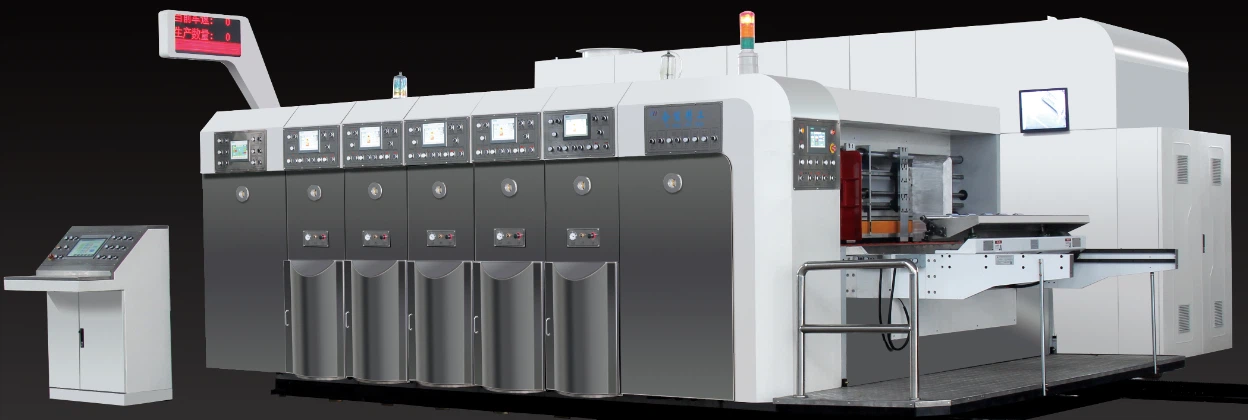
From flat base paper to robust cardboard, the creation of corrugated cardboard boxes is a continuous process carried out by a massive automated production line. The three primary phases involved are "forming," "compounding," and "shaping."
The following steps can be used to break down its fundamental mechanism and operation:
Step 1: Corrugated Forming - Single facer Machine
The single facer machine is the fundamental component of this production line. Its job is to create a single-sided cardboard by pressing the flat "core paper" into a wavy shape and then bonding it with a layer of "face paper" right away.
Heating and pressing: To get rid of extra moisture, a roller preheats the base paper. The core paper then passes through the space between the upper and lower corrugated rollers. Similar to two gears, these two rollers have tooth-shaped surfaces that squeeze the core paper into a wavy pattern at the meshing point.
Key adsorption technology: Old-fashioned machines employ "guide claws" to hold the created wavy paper, but they are slow and prone to wear and tear.
Modern solution: Vacuum adsorption is frequently used in high-speed machines today. The bottom corrugated roller's surface has numerous tiny holes that are coupled to a fan to create negative pressure and securely "suck" paper onto the roller surface, guaranteeing precision and stability when operating at high speeds.
Glue coating and lamination: The glue coating roller will accurately apply a thin layer of glue to the "top" of the corrugated wall after it has been formed and firmly adhered. A flat, two-layer, single-sided cardboard is then created by securely adhering another heated surface paper to the adhesive-coated corrugated core paper while the pressure roller is rolling.

Step 2: Double-sided Multilayer Composite Machine
A double-sided machine is required if you require three, five, or even seven layers of cardboard. It will join other layers of cardboard and the single-sided cardboard made by other single-sided machines like a sandwich. Typically, starch adhesive is applied, followed by a lengthy heating and drying process to create a final corrugated cardboard that is flat and rigid.

Step 3: Drying Equipment for Precision Cutting
The "drying" equipment finishes cutting the wide cardboard into the customer's desired size after it exits the double-facer machine.
First, use a longitudinal cutting and creasing machine to precisely chop off uneven burrs and press out the vertical indentation needed for folding into boxes.
Cross-cutting machine: Depending on the length of the order, cut the cardboard horizontally like a guillotine.
Stacker: In order to finish production, the cut cardboard is automatically stacked properly.
From cardboard to cardboard box after molding
The finished product must be finished on a printing slotting machine after the flat cardboard is converted into cardboard boxes that can hold objects:
Printing: Printing text and product patterns.
Slotting/corner cutting: Cut off the box tongue for joining and the shaking lid at the bottom of the box.
Joining: Ultimately, an empty cardboard box is created by gluing or nailing the boxes together.